


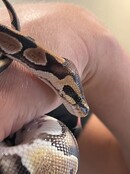
Adoption Details For Boo aka Baby Boo!

Name:
Boo aka Baby Boo
Animal Id:
8362
Date Created:
9/6/2022 2:21:40 PM
Age:
5 Year(s) 9 Month(s) Old
Type:
Snake
Gender:
Undetermined
Primary Breed:
Ball Python
Spayed / Neutered:
No
Secondary Breed:
Microchip:
Primary Color:
Brown
Markings:
Secondary Color:
Black
Pattern:
Weight:
0 lbs
Hi there — my name is Boo (or Baby Boo, if you like!) 🐍💛, and I’m ready to find my forever home in 2026.
I’m a gentle, calm, and affectionate ball python who loves warmth, comfort, and a little quiet time exploring my space.
My story began in a less-than-ideal way. I was bought as a baby from a pet store, but when my first family moved out of state, I was sadly left behind. Thankfully, some kind humans made sure I was safe and brought me to rescue, where I’ve been thriving in a cozy foster home ever since. I’ve grown into a calm, steady little snake with just the right amount of curiosity — and I’ve earned the nickname “Baby Boo” for my gentle personality.
I’m a classic ball python in many ways, but my clear patterns and soft colors might give me a little “sparkle” — my foster family thinks I might have a hint of blade or yellow belly in my lineage. Most of my day, you’ll find me tucked into my favorite hide, but I love coming out in the evenings (and sometimes mornings!) to explore. I especially enjoy burrowing into fresh sphagnum moss — it keeps me comfy and helps me shed beautifully!
✨ Ball Python – Species & Personality Facts ✨
• Typically grow to 3–5 feet as adults
• Lifespan: 30–40 years in captivity with proper care
• Calm, gentle, and easy to handle — perfect for a responsible keeper
• Primarily nocturnal — most active in the evenings and nights
• Curl into a tight “ball” when unsure, which is where our name comes from
• Love hides and burrows, which helps me feel safe and secure
🏠 Husbandry & Enclosure Requirements 🏠 (The rescue will help guide you)
• Minimum enclosure size: 4 feet long × 2 feet wide × 2 feet tall (bigger is always better)
• Front-opening enclosures are ideal for reducing stress with a screen top to manage
• Temperature gradient: warm side 88–92°F, cool side 78–80°F
• Humidity: moderate, with access to a water bowl for soaking
• Multiple hides help me feel safe and secure
• Simple, naturalistic décor works best — function over clutter
🐍 I’m looking for a human who:
• Can provide safe, thermostat-controlled heat 🔥
• Knows (or wants to learn) proper ball python care, including temperature, humidity, and safe handling
• Can give me time to settle in — 3 days to decompress, 3 weeks to build trust, and 3 months to feel at home truly ⏳
I’m calm, steady, and ready to bring a little peace and gentle charm into the right home. Could 2026 be our year together? 🏡✨
✨ PLEASE NOTE:
🎁 We can only accept applications from interested parties who are in or near San Diego County, California at this time.
❄️ We do not ship reptiles 🚫✈️ but we may be willing to work with you if you are willing to travel 🚗
🌟 #2 (snowflake) will depend on the animal that you are applying for and is at the discretion of the board of directors.
💌 If you’d like to make me part of your family, please click the Adoption Application button below — I can’t wait to meet you! 🎁✨




Quick Reference Guide
Animal Type
Snake
Breed
Ball Python
Introduction
Ball pythons, also known as the Royal Python, are a non-venomous, constrictor species native to the bushlands and savannas of Central and Western Africa. They are a medium-sized snake ranging from 3-6 feet. These snakes are crepuscular, which means that they are most active at night, but especially active around dawn and dusk. As ambush hunters, they actively track down and then wait for prey such as rodents, birds, and lizards to scurry past before striking. Ball pythons are sexually dimorphic, which means there is a noteworthy difference in size between males(smaller) and females (larger), but not as large in some other snake species. Ball pythons have a 15-30 year lifespan in captivity.
Difficulty
Beginner
Difficulty Notes
Ball pythons are among the most popular pet snakes. They are good beginner snakes because they are docile and easy to handle.
Basking Temp
95-104
Ambient Temp
80-86
Lowest Temp
72-78
Temp Notes
The use of undertank heat mats with glass tanks or radiant heat panels as internal heaters for night heat, and cage guarded halogen/incandescent bulbs as day heat is preferred. Never install any heating device without plugging it into a thermostat and always securely wire the thermostat probe within the heating range of the device generating heat.
Diet
Carnivore
Diet Notes
Frozen thawed rodents in sizes equal to the girth of your snake at its center. Feeding frequency in general is 1 prey item fed in intervals coorisponding to the length in feet of your snake. A one foot snake would be fed weekly, a 4 foot snake every 4 weeks, etc. As ball pythons get larger their metabolism slows down. This is a guidleine, so adjust to the health of your specific snake to maintain a healthy weight.
UVA Intensity
Shade Dweller
UVB Intensity
Low/Occasional
Ferguson Zone
2
Lighting Notes
Provide 12hrs of both light and darkness on a timer for consistancy. Never use colored bulbs.
Enclosure Size
Large Semi-Arborial
Enclosure Notes
While females are largely terrestrial, males and juviniles are considered semi-arborial as they have a liking to climb and hunt in trees.
Substrate
Coco Chips
Substrate Notes
Coconut husk chip substrate absorbs odors and moisture very well. A layer of about 4" is preferred.
Humidity
High (70-100%)
Humidity Notes
Ball Pythons prefer humid environments and should be provided a humid hide if possible.
Animal Reference Material:
| Category | Title | AnimalType | Breed | |
|---|---|---|---|---|
| Animal Care | *Reptile Rescue Care Standards For Snakes | Snake | ||
| Animal Care | *SBRSC Ball Python Information Guide for Adoption | Snake | Ball Python | |
| Animal Care | Ball Python Care: Feeding, Housing and Handling | Snake | Ball Python | |
| Animal Care | Snake UVB Lighting: What you need to know! | Snake | ||
| Blog | [VIDEO] Is a Ball Python right for me? | Snake | Ball Python |