


Adoption Details For Bucatini!
This animal is no longer available for adoption

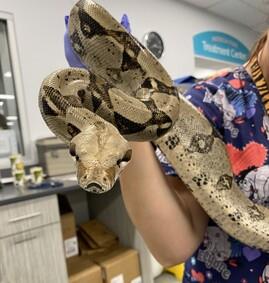
Name:
Bucatini
Animal Id:
2247
Date Created:
8/30/2021 1:59:18 AM
Age:
8 Year(s) 9 Month(s) Old
Type:
Snake
Gender:
Undetermined
Primary Breed:
Common Boa Constrictor
Spayed / Neutered:
No
Secondary Breed:
Microchip:
Primary Color:
Gray
Markings:
2247, WW, T2, K1
Secondary Color:
Red
Pattern:
Weight:
15 lbs
PENDING ADOPTION!!!
Hi there — my name is Bucatini, and 2026 is my year to find my forever family. 🤍✨
I’m a gentle giant boa with a calm, curious nature, and I’m ready to find a home where I can truly be cherished.
My journey hasn’t been easy. I was found exploring a backyard, far from home, and ended up at a shelter where my previous owner never came for me. Even so, I never lost my gentle spirit. In August 2021, I was welcomed into rescue, where I’ve been thriving in loving care and patiently waiting for the right family — someone who will see me for the calm, affectionate, and curious companion I am.
At 9 feet long and 20 pounds, I’m a breathtaking, still-growing boa who enjoys meeting new people, whether at adoption events or during quiet moments with my caretakers. Everyone who meets me notices my gentle demeanor, steady temperament, and unique personality. Because of my size and strength, I’ll do best with a family who has experience caring for big snakes. Thoughtful, careful handling keeps both me and everyone around me safe, and I should always be supervised around small children.
✨ Boa – Species & Personality Facts ✨
• Can grow 9–12 feet long as adults
• Calm, gentle, and curious, especially when approached respectfully
• Solitary by nature — prefer our own space and cozy hides
• Enjoy exploring and interacting with people in calm settings
• Lifespan: 20–30 years in captivity with proper care
• Require consistent, patient handling for the best bond
🏠 Husbandry & Enclosure Requirements 🏠
• Minimum enclosure: 6 feet long × 2.5 feet wide × 2.5 feet tall (larger is always better) - The rescue will help to guide you.
• Enclosures should prioritize ground space over height
• Front-opening enclosures are ideal for safe, low-stress access
• Temperature gradient: warm side 88–92°F, cool side 78–82°F
• Moderate humidity, with access to a water bowl large enough to soak
• Multiple sturdy hides to feel secure
• Simple, functional décor works best — cozy and safe
🐍 I’m looking for a human who:
• Can provide safe, thermostat-controlled heat 🔥
• Knows (or wants to learn) proper boa care, including temperature, humidity, and safe handling
• Can respect my body language and boundaries, as I may be a bit testy at times
• Can give me time to settle in — 3 days to decompress, 3 weeks to build trust, and 3 months to truly feel at home ⏳
I’m calm, steady, and ready to bring a little peace, curiosity, and gentle charm into the right home. Could 2026 be our year together? 🏡✨
✨ PLEASE NOTE:
🎁 We can only accept applications from interested parties who are in or near San Diego County, California at this time.
❄️ We do not ship reptiles 🚫✈️ but we may be willing to work with you if you are willing to travel 🚗
🌟 #2 (snowflake) will depend on the animal that you are applying for and is at the discretion of the board of directors.
💌 If you’d like to make me part of your family, please click the Adoption Application button below — I can’t wait to meet you! 🎁✨
Quick Reference Guide
Animal Type
Snake
Breed
Common Boa Constrictor
Introduction
Boa imperator is a wide-ranging species, living in both Central America and the northern parts of South America. As a result, the appearance of this snake varies greatly depending on the specific locality. As one of the smaller Boa species, they average between 4.2 ft. and 8.2 ft. in length when fully grown, but have been known to reach 12 ft. They usually weigh around 13 lb, although females are significantly larger than males. Lifespan in the wild is around 20–30 years, but 40 can be exceeded in captivity. These snakes are nocturnal, which means that they are most active at night.
Difficulty
Intermediate
Difficulty Notes
Boa imperator is one of the most common snakes kept in captivity; this is mainly due to their calm dispositions, impressive size potential and variety of color and pattern choices. It can be a little diffcult to read their body language if you are inexperienced. Captive common boas often tolerate being handled for extended periods.
Basking Temp
80-90
Ambient Temp
80-90
Lowest Temp
75-80
Temp Notes
Boas do best when there is a temperature gradient in their enclosure. Make sure to provide a hot end and cold end so that they can sel regulate thier own temperature.
Diet
Carnivore
Diet Notes
As a general rule, a meal should weigh no more than 10% of your boa’s weight, or no larger than the widest part of the snake’s body. In the first year it is best to feed weekly, but as the snake gets older its metabolism slows down and you will need to increase the time between feeding up to 4-6 weeks for an adult. This will need to be adjusted to your specific snake to maintain a healthy weight.
UVA Intensity
Tropical
UVB Intensity
Low/Occasional
Ferguson Zone
2
Lighting Notes
While they are nocturnal, they may bask during the day when night-time temperatures are too low.
Enclosure Size
Large Semi-Arborial
Enclosure Notes
As semi-arboreal snakes, young Boa imperator may climb into trees and shrubs to forage; however, they become mostly terrestrial as they become older and heavier.
Substrate
Coco Chips
Substrate Notes
It’s extremely absorbent, fluffy, holds moisture well, and cheap. Plus it’s much more eco-friendly than peat.
Humidity
High (70-100%)
Humidity Notes
While boas can tollerate higher humidity for short periods of time, it can lead to resperatory infection. A target humidity on the lower side near 70% is ideal with periods of higher humidty durring shedding.
Animal Reference Material:
| Category | Title | AnimalType | Breed | |
|---|---|---|---|---|
| Animal Care | *Reptile Rescue Care Standards For Snakes | Snake | ||
| Animal Care | *SBRSC Large Boa Consrictor Information Guide for Adoption | Snake | Common Boa Constrictor | |
| Animal Care | Common Boa Constrictor Care: Feeding, Housing, and Handling | Snake | Common Boa Constrictor | |
| Animal Care | Snake UVB Lighting: What you need to know! | Snake |
This animal is no longer available for adoption